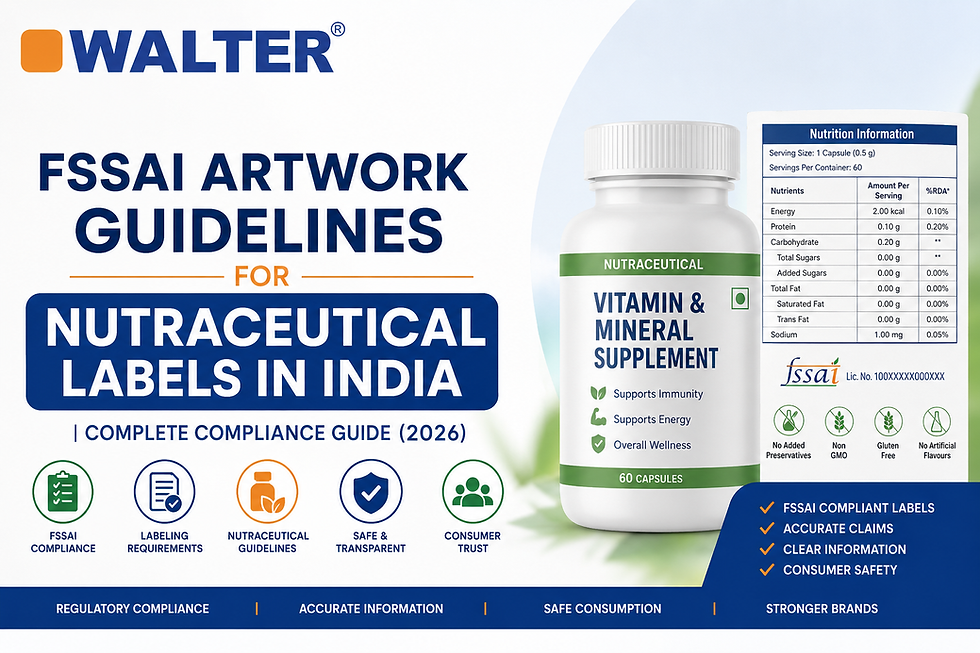
FSSAI Artwork Guidelines for FSSAI Artwork Guidelines for Nutraceutical Labels in India | Complete Compliance Guide (2026)
Learn the complete FSSAI artwork requirements for nutraceutical products in India. Explore mandatory labeling elements, claims, typography, packaging compliance, common mistakes, and best practices for nutraceutical manufacturers.
Introduction
Why Artwork Compliance Matters More Than Ever
With India's nutraceutical market projected to exceed USD 18 billion by 2030, regulators have significantly increased scrutiny of labeling and promotional claims. Consumers have also become more informed and demand transparency regarding ingredients, dosage, safety, and intended use.
For manufacturers, marketers, and brand owners, understanding FSSAI artwork requirements is no longer optional it is essential for successful commercialization.
This comprehensive guide explains every major aspect of nutraceutical artwork compliance under current FSSAI regulations.
Regulatory Framework Governing Nutraceutical Artwork
Artwork approval is governed by multiple regulations rather than a single document.
The major regulatory references include:
Food Safety and Standards Act, 2006
Food Safety and Standards (Labelling and Display) Regulations, 2020
Food Safety and Standards (Health Supplements, Nutraceuticals, Food for Special Dietary Use, Food for Special Medical Purpose, Functional Food and Novel Food) Regulations, 2022
Food Safety and Standards (Advertising and Claims) Regulations, 2018
Food Safety and Standards (Packaging) Regulations, 2018
Together, these regulations prescribe:
Mandatory declarations
Nutritional information
Ingredient disclosure
Warning statements
Usage instructions
Font size
Placement requirements
Health claims
Prohibited claims
Packaging material requirements
What is Considered a Nutraceutical?
Under FSSAI regulations, nutraceuticals include products intended to supplement normal diets by providing concentrated sources of nutrients or other substances having nutritional or physiological effects.
Examples include:
Multivitamins
Mineral supplements
Omega-3 capsules
Protein powders
Herbal extracts
Probiotics
Prebiotics
Plant-based supplements
Antioxidant formulations
Sports nutrition products
Immunity boosters
Unlike pharmaceutical drugs, nutraceuticals cannot claim to diagnose, treat, cure, or prevent diseases.
Mandatory Elements on Every Nutraceutical Label
Every nutraceutical artwork must include the following mandatory information.
1. Product Name
The product name should clearly identify the food category.
Example:
Vitamin C Tablets
Ashwagandha Capsules
Protein Supplement Powder
The category should never mislead consumers.
2. Food Category Declaration
The principal display panel must contain statements such as:
Nutraceutical
or
Health Supplement
or
Food for Special Dietary Use
depending upon product classification.
3. FSSAI Logo and License Number
Every package must display:
FSSAI Logo
14-digit License Number
Example
Lic. No. 100XXXXXXXXXXXXX
The logo should remain clearly visible and legible.
4. Net Quantity
Examples:
Net Quantity: 60 Capsules
Net Weight: 300 g
Net Volume: 200 ml
5. Ingredient List
Ingredients should appear in descending order by weight.
Example
Ingredients:
Vitamin C
Amla Extract
Zinc Sulphate
Microcrystalline Cellulose
Magnesium Stearate
6. Nutritional Information
The nutrition panel must include:
Energy
Protein
Carbohydrate
Total Sugar
Added Sugar
Fat
Saturated Fat
Trans Fat
Sodium
Additionally:
Active nutraceutical ingredients
Vitamins
Minerals
Botanical extracts
must be declared.
Recommended Daily Usage
Artwork should clearly mention:
Recommended Usage
Take one capsule daily after meals
OR
Consume two scoops with 250 ml water.
Consumers should never be left guessing dosage.
Mandatory Warning Statements
Depending on the product, warning statements may include:
Not for medicinal use.
Do not exceed recommended daily usage.
Keep out of reach of children.
Pregnant or lactating women should consult healthcare professionals before use.
People taking medication should seek medical advice before consumption.
Not intended for children unless specifically recommended.
These warnings should be prominent.
Vegetarian and Non-Vegetarian Symbol
Products must display:
Green Dot
or
Brown Dot
as applicable.
Batch Information
Artwork should provide space for:
Batch Number
Manufacturing Date
Expiry Date
Best Before
MRP
Customer Care Details
Manufacturer Information
Include:
Manufacturer Name
Complete Address
Customer Care Email
Customer Care Phone Number
Country of Origin
FSSAI License
Storage Conditions
Examples:
Store in a cool and dry place.
Protect from sunlight.
Keep container tightly closed.
Allergen Declaration
If applicable:
Contains Soy
Contains Milk
Contains Wheat
Manufactured in a facility processing peanuts.
Font Size Requirements
FSSAI prescribes minimum font sizes depending upon package dimensions.
Small packs often require reduced font sizes while larger packs require larger text.
Mandatory declarations should never become unreadable because of decorative artwork.
Design agencies frequently reduce fonts to accommodate branding, resulting in non-compliance.
Principal Display Panel (PDP)
The Principal Display Panel is the portion most visible to consumers.
It generally includes:
Brand Name
Product Name
Food Category
Net Quantity
The PDP should not become cluttered with excessive marketing claims.
Claims Allowed Under FSSAI
FSSAI permits:
Nutrient Content Claims
Example:
High in Vitamin C
Rich in Protein
Source of Calcium
Comparative Claims
Example:
30% Less Sugar
Low Fat
Function Claims
Example:
Supports normal immune function
Helps maintain bone health
Supports energy metabolism
These claims must have scientific substantiation.
Claims That Are Strictly Prohibited
Artwork must never include:
Cures Diabetes
Treats Arthritis
Prevents Cancer
Guaranteed Weight Loss
100% Cure
Doctor Approved
Clinically Proven (without evidence)
Instant Relief
Permanent Solution
Such claims violate FSSAI Advertising Regulations.
Use of Scientific Images
Manufacturers frequently use:
DNA graphics
Heart icons
Joint diagrams
Brain illustrations
Liver images
These should not imply therapeutic efficacy.
Visuals should remain educational rather than medicinal.
QR Codes and Digital Information
Modern nutraceutical labels increasingly include QR codes linking consumers to:
Certificates
Ingredient Traceability
Lab Reports
Clinical Studies
Usage Videos
Although optional, QR codes enhance transparency.
Barcode Placement
Artwork should leave sufficient white space around barcodes.
Poor barcode placement often leads to scanning failures in retail stores.
Colour Selection
Regulations do not prescribe colours.
However:
Warning statements should contrast with the background.
Text should remain readable.
Metallic finishes should not obscure declarations.
Common Artwork Mistakes Observed During Regulatory Review
Regulatory teams frequently identify:
Missing FSSAI logo
Missing license number
Incorrect product category
Wrong botanical nomenclature
Improper ingredient sequence
Unauthorized health claims
Tiny font size
Missing warning statements
Incorrect nutrition table
No allergen declaration
Improper net quantity declaration
Incorrect serving size
These issues delay product launches.
Artwork Approval Workflow
A robust artwork approval system generally follows:
Marketing Team develops artwork
↓
Regulatory Affairs reviews compliance
↓
Quality Assurance verifies declarations
↓
Legal review
↓
Brand approval
↓
Printer proof verification
↓
Commercial printing
↓
Final packaging release
Every revision should be version controlled.
Importance of Scientific Review
Every health claim should be supported through:
Published literature
Ingredient monographs
FSSAI approvals
Scientific dossiers
Global regulatory references
Marketing teams should avoid creating unsupported promotional statements.
Multilingual Artwork
Products marketed across India often include:
English
Hindi
Regional languages
Translations must preserve regulatory meaning.
Incorrect translation may constitute misbranding.
Imported Nutraceutical Products
Imported products require additional declarations including:
Importer Name
Importer Address
Country of Origin
Veg/Non-Veg Symbol
FSSAI License
Indian nutrition format
Indian warning statements
Simply placing a sticker is insufficient if mandatory information remains missing.
Packaging Material Compliance
Artwork alone does not ensure compliance.
Packaging materials should comply with:
Migration limits
Food-grade standards
Heavy metal requirements
Printing ink safety
Food-contact regulations
Shelf-Life Declaration
Examples include:
Best Before 24 Months from Manufacturing
Use By
Expiry Date
Shelf-life declarations should match validated stability studies.
Best Practices for Mastering Artwork Compliance
Achieving regulatory excellence isn't just about avoiding penalties it's about building operational efficiency. To stay ahead of compliance curves, manufacturers should:
Build Robust Compliance Checklists: Create master checklists that act as your first line of defense against common regulatory oversights.
Standardize Your Assets: Maintain locked, pre-approved templates for warning statements and mandatory declarations to ensure consistency.
Prioritize Pre-Print Review: Conduct a thorough regulatory review before files go to the printer to avoid costly re-runs.
Rigorous Version Control: Implement a strict version history system so that every change is tracked, approved, and auditable.
Upskill Your Marketing Team: Regularly train marketing and design teams on regulatory nuances so compliance is designed in, not added on.
Institutionalize Audits: Periodically audit printed labels against the latest FSSAI notifications to catch drift early.
Monitor the Regulatory Landscape: Keep a live pulse on FSSAI updates to ensure your library of claims and requirements stays current.
Integrated Quality Management: Make artwork approval a core component of your Quality Management System (QMS), not an isolated design task.
Leveraging Digital Artwork Approval Systems
Manual approvals are prone to human error. Modern market leaders are transitioning to automated, centralized workflows to scale their compliance:
Centralized EDMS: Utilize Electronic Document Management Systems to store and retrieve the "source of truth" for every label.
Automated Workflow Routing: Replace email chains with systems that automatically route designs from Marketing to Regulatory, Legal, and QA for sequential sign-offs.
Digital Audit Trails: Use digital signatures and automated logs to maintain a perfect compliance record for every SKU.
Intelligent Checklists: Deploy software that flags missing mandatory elements or incorrect font sizes before human review even begins.
These significantly reduce artwork errors.
Role of Regulatory Affairs in Artwork Approval
Regulatory professionals ensure:
Compliance with FSSAI regulations
Scientific accuracy
Correct claims
Proper nutrition declarations
Ingredient verification
Legal compliance
Label harmonization across SKUs
Their review protects companies from costly regulatory actions.
Business Risks of Non-Compliant Artwork
Failure to comply with labeling regulations may result in:
Product seizure
Regulatory notices
License suspension
Market withdrawal
Consumer complaints
Brand reputation damage
Export rejection
Financial penalties
Product recall
Litigation
Artwork errors often become far more expensive than correcting them before printing.
Future Trends in Nutraceutical Artwork
The future of packaging compliance will likely include:
Smart QR-enabled labels
Digital ingredient traceability
AI-assisted artwork validation
Blockchain-based supply chain transparency
Sustainable packaging declarations
Personalized nutrition labeling
Interactive consumer information platforms
Companies adopting digital compliance tools today will gain a competitive advantage.
How Walter Healthcare Ensures Artwork Excellence
At Walter Healthcare, artwork development is treated as a critical regulatory process rather than a design activity. Every nutraceutical label undergoes a structured, cross-functional review by the Regulatory Affairs, Quality Assurance, Production, and Marketing teams to ensure full alignment with applicable FSSAI requirements.
Our artwork review process focuses on:
Verification of mandatory FSSAI declarations
Scientific validation of nutrition and health claims
Ingredient and allergen accuracy
Compliance with font size and display requirements
Packaging and labeling consistency across product variants
Final print-proof approval before commercial release
By integrating regulatory compliance into the artwork lifecycle, Walter Healthcare helps brand owners reduce approval delays, avoid costly reprints, and launch products with confidence.
Conclusion
Nutraceutical artwork is far more than a branding exercise; it is a regulatory commitment to consumer safety, transparency, and legal compliance. Every label serves as the primary communication tool between the manufacturer and the consumer, conveying essential information about product identity, ingredients, usage, nutrition, and safety.
As FSSAI continues to strengthen oversight of health supplements and nutraceuticals, businesses must adopt a proactive approach to artwork development. Cross-functional collaboration between marketing, regulatory affairs, quality assurance, and packaging teams is essential to ensure every printed label meets current legal requirements while maintaining strong visual appeal.
Organizations that invest in standardized artwork review processes, scientific substantiation of claims, and regular regulatory updates not only minimize compliance risks but also build lasting consumer trust. In an increasingly competitive nutraceutical market, compliant artwork is not merely a legal obligation it is a strategic asset that reinforces brand credibility, facilitates faster product approvals, and supports long-term business growth.


Comments