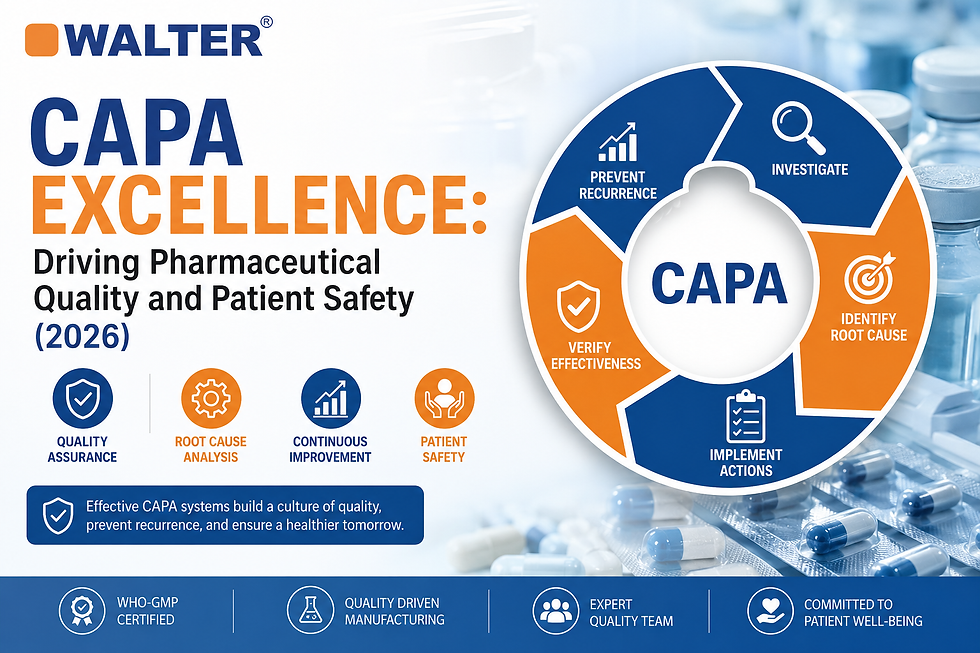
CAPA Excellence: Driving Pharmaceutical Quality and Patient Safety (2026)
Mastering root cause analysis and proactive risk mitigation through robust CAPA frameworks to ensure unwavering patient safety, seamless regulatory compliance, and sustainable operational excellence within the evolving 2026 global landscape.
Introduction
In the pharmaceutical world, patient safety isn't just a metric it's our North Star. Every product must achieve flawless standards of quality and efficacy. Even a minor deviation risks batch rejection, costly recalls, and, most critically, the health of the patients who trust us.
Top-tier manufacturers don't just fix problems; they outpace them. By identifying why an issue occurred and neutralizing its root cause, companies transform failures into blueprints for future success. This proactive philosophy defines Corrective and Preventive Action (CAPA).
CAPA serves as the engine of a high-performance Pharmaceutical Quality System (PQS). It shifts quality management from reactive "firefighting" to a results-oriented strategy that optimizes processes across manufacturing and the global supply chain.
Authorities such as the FDA, WHO, EMA, and CDSCO require a robust CAPA system. During GMP inspections, your CAPA records tell the story of your quality culture and your commitment to operational excellence.
This comprehensive guide explores CAPA in pharmaceuticals, its importance, regulatory framework, implementation process, root cause analysis methodologies, industry best practices, and how an effective CAPA system strengthens regulatory compliance and operational excellence.
What is CAPA?
CAPA is a systematic, rigorous investigation into quality discrepancies. It determines root causes, executes corrective measures, and builds defenses to ensure the same error never happens twice.
Although frequently used together, Corrective Action and Preventive Action serve different objectives.
Corrective Action
Corrective Action swiftly eliminates the root cause of an existing non-conformance. It is the immediate response to ensure quality integrity is restored.
Examples include:
Batch failures
Out-of-Specification (OOS) results
Product complaints
Market complaints
Equipment failures
Packaging defects
Stability failures
Audit observations
Regulatory inspection findings
Preventive Action
Preventive Action is your strategic foresight. It identifies potential failure points before they manifest, hardening your systems against future risks.
Examples include:
Process optimization
Trend analysis
Preventive maintenance
Additional employee training
Automation initiatives
Risk assessments
Supplier qualification improvements
Together, these actions foster a culture of perpetual improvement, ensuring "The Walter Way" where excellence is standard, not an exception.
Why CAPA is Critical in Pharmaceutical Manufacturing
Pharmaceutical manufacturing is a complex web of interconnected stages. A failure at any point can jeopardize the entire output. A precision CAPA system doesn't just satisfy auditors; it secures your business.
An elite CAPA system delivers distinct competitive advantages:
Upholds uncompromising patient safety
Drives consistent, high-yield product quality
Eliminates the waste of recurring deviations
Slashes operational and manufacturing costs
Accelerates process efficiency and throughput
Enhances regulatory compliance
Strengthens inspection readiness
Increases customer confidence
Foster a quality-driven organizational culture
Rather than treating individual incidents as isolated events, CAPA encourages organizations to identify systemic weaknesses and implement sustainable improvements.
Regulatory Framework Governing CAPA
CAPA is not merely a best practice it is a regulatory expectation across global pharmaceutical markets.
1. US FDA – 21 CFR Part 211
Section 21 CFR §211.192 requires manufacturers to thoroughly investigate unexplained discrepancies and batch failures, regardless of whether the affected batch has been distributed.
The FDA expects investigations to identify scientifically justified root causes and implement effective CAPA to prevent recurrence.
2. WHO Good Manufacturing Practices
WHO GMP requires manufacturers to establish systems for:
Deviation investigations
Complaint handling
Root cause analysis
CAPA implementation
Continuous improvement
These requirements are outlined in:
WHO Technical Report Series (TRS) No. 986, Annex 2
WHO Technical Report Series (TRS) No. 1044, Annex 2
3. ICH Q10 – Pharmaceutical Quality System
ICH Q10 identifies CAPA as one of the four essential elements of an effective Pharmaceutical Quality System.
The guideline emphasizes:
Investigation of quality events
Root cause determination
Risk-based CAPA
Effectiveness verification
Continuous improvement
4. ICH Q9(R1) – Quality Risk Management
ICH Q9(R1) recommends integrating quality risk management into CAPA activities by prioritizing actions based on scientific risk assessment rather than assumptions.
5. EU GMP
EU GMP Chapter 1 mandates rigorous systems for investigating deviations. To operate in Europe, CAPA is your license to compete.
6. Revised Schedule M (India)
In India, the Revised Schedule M requires high-precision documentation and risk management, mirroring global standards to ensure domestic products are world-class.
Deviations
Investigations
CAPA
Change control
Risk management
Product Quality Review (PQR)
Events That Typically Trigger CAPA
CAPA can originate from multiple quality systems, including:
Product complaints
Customer feedback
Batch failures
OOS investigations
OOT results
Deviations
Change control observations
Internal audits
Regulatory inspections
Environmental monitoring failures
Stability failures
Validation deficiencies
Equipment breakdowns
Supplier quality issues
Product recalls
Annual Product Quality Reviews (APQR/PQR)
Pharmacovigilance signals
Every organization should establish predefined criteria for initiating CAPA based on the severity and risk associated with these events.
CAPA Process: Step-by-Step
Step 1: Identify the Problem
The first step is defining the issue accurately.
Questions include:
What happened?
When and where did it occur?
Which product or batch is affected?
How was it detected?
What is the potential impact on product quality and patient safety?
A well-defined problem statement forms the foundation of an effective investigation.
Step 2: Immediate Containment
Before investigating the root cause, organizations should prevent further impact by implementing temporary containment measures.
Examples include:
Quarantining affected batches
Halting production
Segregating materials
Conducting additional testing
Informing stakeholders where appropriate
Containment minimizes risk while the investigation proceeds.
Step 3: Root Cause Analysis
Root Cause Analysis (RCA) is the heart of CAPA. Corrective actions should address the true cause, not merely the symptoms.
Common RCA tools include:
5 Whys
A structured questioning technique that repeatedly asks "Why?" until the underlying cause is identified.
Fishbone (Ishikawa) Diagram
Categorizes potential causes into:
Man
Machine
Material
Method
Measurement
Environment
Fault Tree Analysis (FTA)
A logical, top-down method that traces failures back to their origin.
Pareto Analysis
Uses the 80/20 principle to identify the small number of causes responsible for the majority of problems.
Step 4: Risk Assessment
Not every issue carries the same level of risk.
Organizations should evaluate:
Severity
Probability of occurrence
Detectability
Common risk assessment tools include:
FMEA
Risk matrices
HACCP (where applicable)
A risk-based approach ensures resources are focused on the most critical quality issues.
Step 5: Develop Corrective Actions
Corrective actions should eliminate the verified root cause.
Examples include:
Revising SOPs
Equipment repair or replacement
Process modifications
Manufacturing parameter optimization
Validation updates
Enhanced operator training
Actions should be practical, measurable, and sustainable.
Step 6: Implement Preventive Actions
Preventive actions strengthen the overall quality system.
Examples include:
Trend monitoring
Automation
Preventive maintenance
Supplier audits
Process capability studies
Enhanced quality monitoring
Step 7: Implementation
Implementation should include:
Assigned responsibilities
Defined timelines
Required resources
Documentation
QA oversight
Cross-functional collaboration is essential for successful execution.
Step 8: Effectiveness Verification
One of the most common regulatory observations is closing CAPAs without verifying their effectiveness.
Verification should confirm:
The root cause has been eliminated.
Similar issues are no longer occurring.
Process performance has improved.
Additional monitoring confirms sustained effectiveness.
Step 9: CAPA Closure
A CAPA should only be closed after:
All planned actions are completed.
Supporting evidence is documented.
Effectiveness has been demonstrated.
Quality Assurance approves closure.
CAPA Workflow
Quality Event
↓
Issue Identification
↓
Immediate Containment
↓
Investigation
↓
Root Cause Analysis
↓
Risk Assessment
↓
Corrective Action
↓
Preventive Action
↓
Implementation
↓
Effectiveness Verification
↓
QA Review
↓
CAPA Closure
Best Practices for an Effective CAPA System
An effective CAPA program goes beyond compliance; it drives operational excellence.
Organizations should:
Focus on scientifically supported root causes rather than assumptions.
Use risk-based prioritization for all CAPA activities.
Involve multidisciplinary teams from QA, QC, Production, Engineering, Warehouse, and Regulatory Affairs.
Set SMART (Specific, Measurable, Achievable, Relevant, Time-bound) action plans.
Monitor overdue CAPAs through dashboards or electronic Quality Management Systems (eQMS).
Verify effectiveness before closure.
Analyze CAPA trends during Product Quality Reviews and Management Reviews.
Integrate CAPA with deviations, complaints, change control, audits, and risk management.
Continuously train employees on investigation techniques and documentation practices.
Promote a culture where reporting issues is encouraged rather than discouraged.
Common CAPA Mistakes
Regulatory inspections frequently identify weaknesses such as:
Treating symptoms instead of root causes.
Closing CAPAs prematurely.
Poor investigation documentation.
Inadequate risk assessments.
Repeated CAPAs for the same issue.
Failure to update SOPs and training records.
Missed implementation deadlines.
Lack of management review.
Ineffective trend analysis.
Avoiding these pitfalls significantly improves inspection outcomes.
Benefits of a Strong CAPA System
Organizations with mature CAPA systems consistently experience:
Higher product quality.
Reduced deviations and complaints.
Improved process capability.
Lower manufacturing costs.
Better regulatory inspection performance.
Enhanced customer confidence.
Stronger supplier relationships.
Improved operational efficiency.
Increased employee accountability.
Continuous improvement across the organization.
Ultimately, CAPA contributes directly to safer medicines and better patient outcomes.
Why Choose Walter Healthcare as Your Manufacturing Partner?
At Walter Healthcare, quality is our heartbeat. As a WHO-GMP certified leader, we don't just follow standards we set them. Our Pharmaceutical Quality System is engineered for one goal: absolute safety and regulatory triumph.
Our CAPA engine powers every facet of our operations. We use battle-tested root cause analysis to verify that every solution we implement is permanent, effective, and science-driven.
Our quality philosophy is supported by:
WHO-GMP compliant manufacturing facilities.
Risk-based Pharmaceutical Quality System aligned with ICH Q10.
Scientific Root Cause Analysis using internationally recognized methodologies.
Comprehensive documentation and data integrity practices.
Qualified Quality Assurance and Regulatory Affairs professionals.
Continuous employee training and competency development.
Ongoing monitoring through internal audits and Management Reviews.
Commitment to continuous improvement and customer satisfaction.
Whether you require third-party manufacturing, contract development, private label manufacturing, or regulatory support, Walter Healthcare delivers pharmaceutical products that meet the highest standards of quality, compliance, and reliability.
Conclusion
CAPA is the catalyst for perfection. It transforms the "The Walter Way" into a sustainable competitive advantage, turning every challenge into an opportunity to harden our processes and protect our patients.
As regulatory expectations continue to evolve, pharmaceutical companies that invest in robust CAPA systems will be better positioned to achieve inspection readiness, maintain product quality, reduce operational risks, and protect patient safety. CAPA should not be viewed as a reactive exercise following a deviation but as a strategic quality management tool that strengthens every aspect of the Pharmaceutical Quality System.
At Walter Healthcare, our commitment to quality extends beyond compliance. By integrating CAPA into every stage of our operations, we help ensure that every product leaving our facility reflects the highest standards of safety, efficacy, and regulatory excellence. For organizations seeking a trusted manufacturing partner, a strong CAPA culture is one of the clearest indicators of long-term reliability, and it is a standard we strive to uphold every day.



Comments