CDSCO VS State FDA: Approval Authority in India
Navigate the distinct roles of CDSCO and State FDA to ensure faster approvals, full compliance, and successful market entry.

1. Introduction
Navigating India's dynamic pharmaceutical market can be complex, especially with its unique two-tiered regulatory system. Pharmaceutical manufacturers and regulatory professionals often find themselves at a crossroads: should they approach the Central Drugs Standard Control Organization (CDSCO) or the State Food and Drug Administration (FDA) for product approvals? Understanding this distinction is vital to ensure a smooth regulatory journey and avoid costly delays or rejections.
At the national level, the CDSCO, under the Ministry of Health and Family Welfare, stands as the apex regulatory body. It holds the crucial responsibility for approving new drugs, overseeing clinical trials, managing biologics and imports, and regulating medical devices. In contrast, State FDAs operate at the state level, tasked with issuing manufacturing and licensing, conducting routine inspections, and ensuring local adherence to the Drugs and Cosmetics Act, 1940.
While both authorities operate under the same overarching legislation, their mandates, approval formats (like CT-21 versus Form 25), and data expectations can differ significantly. Confusion often arises when dealing with novel drug applications, fixed-dose combinations (FDCs), subsequent new drugs (SNDs), or already approved generics, each of which potentially requires a distinct regulatory pathway depending on its approval status and history in India.
At Walter Healthcare, we provide expert guidance to help our clients navigate this complex regulatory landscape. We'll clarify whether your products necessitate central approval from CDSCO or can proceed directly to the State FDA for a manufacturing license.
This post will delve deeply into the scope, responsibilities, and approval pathways of both CDSCO and the State FDA. We'll highlight their key differences and provide a practical guide on when and how to approach each authority, empowering you to make the right regulatory decisions from the very start.
2. Overview of India’s Drug Regulatory System
2.1 Legal Framework
The regulation of drugs and pharmaceuticals in India is primarily governed by two key legislative instruments
The Drugs and Cosmetics Act, 1940
The Act establishes the legal framework for regulating the import, manufacture, distribution, and sale of drugs and cosmetics in India. Its primary objective is to guarantee the safety, efficacy, and quality standards of drugs, while also outlining the powers of both central and state regulatory authorities.
The Drugs and Cosmetics Rules, 1945
These Rules, formulated under the Drugs and Cosmetics Act, detail the essential procedures and prerequisites for the licensing, testing, labeling, and approval of drugs and cosmetics. They establish the regulatory formats, timelines, technical data, and compliance benchmarks that manufacturers and sellers must meet to operate legally within India’s pharmaceutical framework.
These laws comprise India's drug regulatory framework, which sets standards for effectiveness, potency, and capability. They define the roles of central (CDSCO) and state (State FDA) authorities, creating a dual oversight structure where central bodies manage policy and new drug approvals. In contrast, state bodies handle licensing and enforcement.

2.2 Central vs. State Regulatory Roles
India's drug regulation follows a two-tiered system, ensuring both central oversight and local enforcement. This framework divides responsibilities between the Central Drugs Standard Control Organization (CDSCO) and the State Food and Drug Administrations (State FDAs).
CDSCO - The Central Authority
Central Drugs Standard Control Organization (CDSCO), under the Ministry of Health and Family Welfare, is a national-level authority responsible for the approval of new drugs, biologicals, and innovative formulations.
State FDA - State Level Authorities
Each Indian state operates its own Food and Drug Administration (FDA), which functions under the respective state's health department. The FDA is primarily responsible for issuing and renewing various licenses, including manufacturing licenses (Form 25/28) and retail and wholesale sale licenses (Form 20B/21B). Additionally, it conducts Good Manufacturing Practices (GMP) inspections of manufacturing facilities.
While the CDSCO grants approvals nationally, State FDAs are responsible for on-ground implementation and enforcement of these regulations. They ensure daily compliance and quality assurance during manufacturing and distribution.
3. What is CDSCO
3.1 Definition and Functions
Central Drugs Standard Control Organization (CDSCO) is a national regulatory body for pharmaceuticals, cosmetics, and medical devices in India. It functions under the Directorate General of Health Services, Ministry of Health and Family Welfare, with its headquarters in New Delhi, ensuring safety, efficacy, and quality of the products through its regulation of the imports, manufacturing, distribution, and sale.

3.2 Key Responsibilities of CDSCO
Authorization of clinical trials (CT-04, CT-06, etc.)
Approval of new drugs, biologics, and subsequent new drugs (SNDs)
Granting of licenses for importing drugs and APIs
Regulation of medical devices, cosmetics, and diagnostics
Pharmacovigilance oversight and adverse drug reaction reporting
Issuance of NOC, Form CT-21, and Form CT-23
3.3 Products Needing CDSCO Approval
CDSCO is the national regulatory body responsible for approving specific categories of drugs in India. Under the Drugs and Cosmetics Act of 1940 and the Drugs and Cosmetics Rules of 1945, these categories must receive CDSCO approval before manufacturing and marketing.
1. New Drug: These include new chemical entities (drugs not previously approved in India), biologics (therapeutic proteins, monoclonal antibodies, and other products developed using biological systems), and biosimilars (biologic products similar to approved biologics with no significant clinical differences).
Regulatory basis: In India, new drugs are subject to a 4-year approval period from their initial approval date, as stipulated by Rule 122E of the Drugs and Cosmetics Rules. The approval process necessitates the submission of comprehensive data, including:
Pre-clinical and clinical trial data.
Chemistry, Manufacturing, and Control (CMC) information.
Pharmacokinetics and Pharmacodynamic studies.
2. Subsequent New Drugs (SNDs): These include the pre-approved drugs requiring CDSCO review due to
New Dosage Form (previously used as a tablet, now needs to be introduced as an injection).
New Indications ( usage for different diseases and populations).
New Routes of Administration ( oral to topical).
3. Fixed Dose Combination (FDCs): CDSCO approval is required for
A new Fixed-Dose Combination (FDC) containing at least one novel drug.
Any combination of existing drugs not previously marketed in the proposed dosage form or strength.
Modifications to the ratio, indication, or route of administration for already approved FDCs.
4. Imports of Drugs and Investigational Products: Imports of the following products require CDSCO approval
Active Pharmaceutical Ingredients (APIs): Essential chemical components for drug formulation.
Investigation New Drugs (INDs): Unapproved drugs under clinical study.
Finished Pharmaceutical Products (For commercial and clinical trials): Market-ready drugs and those used in trials.
The approval is granted with the import license (Form 10) once the evaluation is completed.
Country of origin manufacturing authorization.
Free Sale Certificate (FSC) required.
GMP certification is mandatory.
Provide Product Quality and Safety Data.
4. What is the State FDA
4.1 Definition and Functions
The State Food and Drug Administration (State FDA) is a state-level government body responsible for enforcing central laws related to food, drugs, and cosmetics within its specific state. Operating under the guidance of the CDSCO and the Food Safety and Standards Authority of India (FSSAI), the State FDA ensures the safety, quality, and affordability of food products, as well as the safety and efficacy of drugs and cosmetics available to the public in their respective states.

4.2 Key Responsibilities of the State FDA
Issuance of the Manufacturing Licenses:
Form 25 (for allopathic drug manufacturing) approval and renewals, and Form 28 (for Schedule C/C1 drugs like injectables and biologicals).
Facilities inspection for GMP compliance as the Schedule M.
Issuing the Sale and Distribution License
Grant retail (Form 20 & 21) and wholesale licenses (Form 20B &21B).
Conducting Inspections and Sampling
Perform routine and surprise inspections of manufacturing and retail units.
Collect samples for testing under Section 23 of the Act and initiate legal proceedings if substandard drugs are found.
Enforcement and Recalls
Act against spurious, adulterated, or misbranded drugs under Section 27 of the Act.
Coordinate with CDSCO in nationwide recalls or regulatory alerts.
Record-keeping and Reporting
Maintain databases of licensed entities and periodic compliance reports.
Submit reports to CDSCO for pharmacovigilance recalls or escalated regulatory action.
4.3 When State FDA Approval is Needed
Approved Drugs Manufacturing
In case the drug has already been approved by CDSCO for more than 4 years, manufacturers can directly reach out to the State FDA for a manufacturing license (Form 25/28) alongside key documentation in terms of stability data, product specification, and GMP certification.
Licensing of Retail/ Wholesale Outlets
Every retail or wholesale drug establishment must obtain valid licenses under Form 20/21/20B/21B, issued by the State FDA.
These licenses require compliance with conditions regarding premises, storage, pharmacist qualification, and record maintenance.
GMP Site inspections
For both new and renewal applications, state-level inspectors assess GMP compliance before granting or renewing manufacturing licenses.
Distribution and Recall Coordination
In the event of substandard and counterfeit drug detection, State FDAs are the first responders for initiating investigation, seizure, and market recall.
5. Key Differences Between CDSCO and State FDA

6. Approval Flow: CDSCO vs State FDA
Approval Scenarios
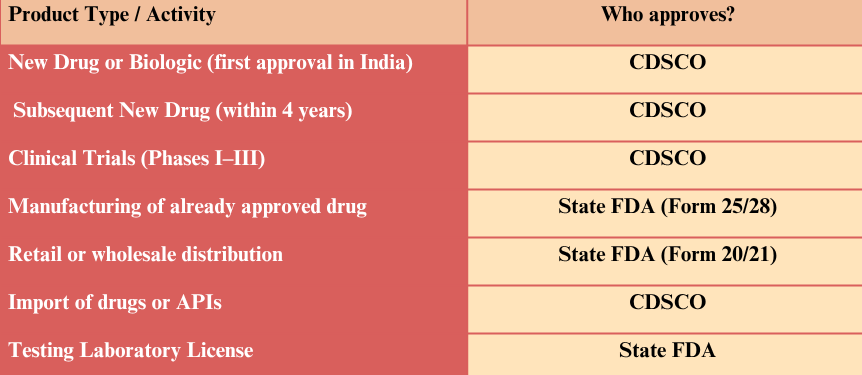
6.1 For New Drugs/SNDs/ FDCs
If you are developing New Drugs (ND), Subsequent New Drug (SND), or a Fixed Dose Combination (FDC) not previously approved in India, here’s the structured approval process.
Step-by-Step Regulatory Process
1. Apply to CDSCO via the SUGAM Portal: All applications must be submitted online through the CDSCO SUGAM Portal.
Select the appropriate category (ND, SND, or FDC).
Ensure classification aligns with Rule 122E of the Drugs & Cosmetics Rules.
2. Submit Supporting Technical Data:
New Drugs:
Preclinical (toxicology/pharmacology)
Phase I–III clinical trial data (unless waived)
SNDs / FDCs:
Bioequivalence (BE) study reports (if required)
Comparative dissolution profiles (CDP)
Justification for combination or changes in dosage/form/route
Refer to Schedule Y for guidance on clinical and BE data requirements.
3. Obtain Approval in Form CT-21: Once approved, CDSCO issues Form CT-21 (Permission to manufacture/import new drug for sale or distribution).
Issued under New Drugs and Clinical Trials Rules, 2019.
4. Apply for a Manufacturing License to the State FDA: Submit CT-21 approval along with the complete product dossier.
Apply under:
Form 25: If manufacturing with a drug license
Form 28: If manufacturing with a loan license
6.2 For Generics/ Already Approved Molecules
The process for generic drugs or products using already-approved Active Pharmaceutical Ingredients (APIs) in India depends on the date and nature of prior CDSCO approval.
A. If the Drug Was Approved in India More Than 4 Years Ago
Such drugs fall under the standard category and are not classified as “New Drugs”. Apply directly to the State FDA
Submit:
Product dossier: Formulation, composition, label, package insert
Stability data: Minimum 3 months accelerated data (or 6 months preferred)
GMP compliance documents: WHO-GMP certificate or valid site approval
No need to approach CDSCO if:
No new indication/dosage form/route of administration
The drug is well-established in the Indian market (>4 years)
B. If the Drug Was Approved Less Than 4 Years Ago or Has Formulation/Indication Changes
Such applications are still classified as SNDs under the New Drugs and Clinical Trials Rules, 2019.
Provide:
Bioequivalence (BE) studies for oral dosage forms
Stability studies per ICH guidelines
Comparative Dissolution Profiles
Justification for any variation from the approved formulation or indication
Once CDSCO grants permission in CT-21, follow up with the State FDA for a manufacturing license.
7. Common Misjudgments
7.1 CDSCO vs State FDA Approval Sufficiency
Misconception: Many believe that once a product receives approval from the Central Drugs Standard Control Organization (CDSCO), no further regulatory approvals are needed for its manufacturing or distribution in India.
The Reality: This is a significant misunderstanding within the regulatory landscape. While the CDSCO grants centralized marketing authorization, this approval does not eliminate the need for a manufacturing license. This license must be obtained from the respective State Licensing Authority (State FDA) where the manufacturing facility is located.
Key Distinction:
CDSCO Approval: Permits the marketing and distribution of the product nationwide, based on an evaluation of its safety, efficacy, and quality.
State FDA License: Authorizes the actual manufacturing of the product and ensures adherence to local Good Manufacturing Practices (GMP) and other statutory requirements.
Regulatory Framework: India operates under a dual regulatory framework:
The CDSCO oversees product approvals and the issuance of import licenses.
State authorities are responsible for granting manufacturing licenses and conducting inspections of manufacturing units within their jurisdiction.
7.2 BE Study Not Needed for State Approval
Misconception: "Bioequivalence (BE) studies are exclusively for CDSCO approvals and hold no significance for State FDA licensing."
Clarification: This common misunderstanding can result in delays or compliance challenges during product licensing.
Reality: While BE studies are a core requirement for CDSCO approval, particularly for generic drugs, it's inaccurate to assume their irrelevance at the State FDA level. State Licensing Authorities may request BE data under specific conditions, especially when assessing:
Fixed Dose Combinations (FDCs)
New Drug Delivery Systems (NDDS)
Modified or novel formulations where therapeutic equivalence to a reference product must be established
Why Might the State FDA Request BE Data? While the CDSCO primarily oversees clinical and bioequivalence studies, State Drug Authorities are responsible for ensuring the safety and efficacy of manufactured products. If a formulation deviates from established norms or lacks sufficient evidence of interchangeability, the State FDA may request bioequivalence data to confirm therapeutic equivalence.
Key Takeaways:
BE studies are not exclusive to central regulatory review.
State FDAs may require BE data during the grant of a manufacturing license for certain product categories.
Proactively including or being prepared with BE data for FDCs and NDDS products can streamline the approval process and avoid unnecessary regulatory hurdles.
8. Why Walter Healthcare
Navigating India's complex pharmaceutical regulations, governed by both CDSCO and State FDAs, requires deep expertise and strategic foresight. Walter Healthcare offers that trusted partnership.

Partner with Confidence
At Walter Healthcare, we offer precision, efficiency, and peace of mind. Partner with us as your regulatory ally to navigate complexities, mitigate risks, and accelerate approvals, allowing you to prioritize innovation and growth.
9. Conclusion
Navigating India's pharmaceutical regulatory landscape, governed by both the Central Drugs Standard Control Organization (CDSCO) and the State Food and Drug Administrations (State FDAs), is inherently complex. While the CDSCO holds primary authority for the approval of new drugs and the regulation of drug imports, the State FDAs are responsible for overseeing the manufacturing, sale, and distribution of drugs within their respective states. A clear understanding of these distinct yet occasionally overlapping roles is crucial, as any misinterpretation can lead to significant and costly delays in drug development, approval, and market entry.
Even Bioequivalence (BE) studies, often associated with central approvals, may be requested by State Licensing Authorities for novel formulations, underscoring the need for meticulous preparation. Companies must consider the molecule's regulatory history, drug type, formulation, and manufacturing jurisdiction.
At this critical juncture, Walter Healthcare acts as a trusted regulatory partner, offering strategic planning, end-to-end support from CT-21 to Form 25/28 submissions, and scientific strength for evidence-based applications. We provide regulatory foresight and foster collaborative relationships, ensuring uninterrupted post-approval continuity with pharmacovigilance, recalls, and audits. Our expertise guides you through both CDSCO and State FDA pathways for efficient product launches.


Sanford Pharmacy is more than just a place to fill prescriptions – it is a trusted partner in your healthcare journey. Dedicated to offering quality medicines and reliable services, Sanford Pharmacy combines professional care with a personal touch.
Different conditions require reliable treatments, and several medications stand out for their effectiveness. Famciclovir is an antiviral used to manage herpes infections like shingles and cold sores, helping shorten outbreaks and reduce discomfort.
“It’s interesting to learn how CDSCO and State FDA handle medicine approvals differently — I came across Grant Pharmacy mentioning how such regulations affect product availability.